

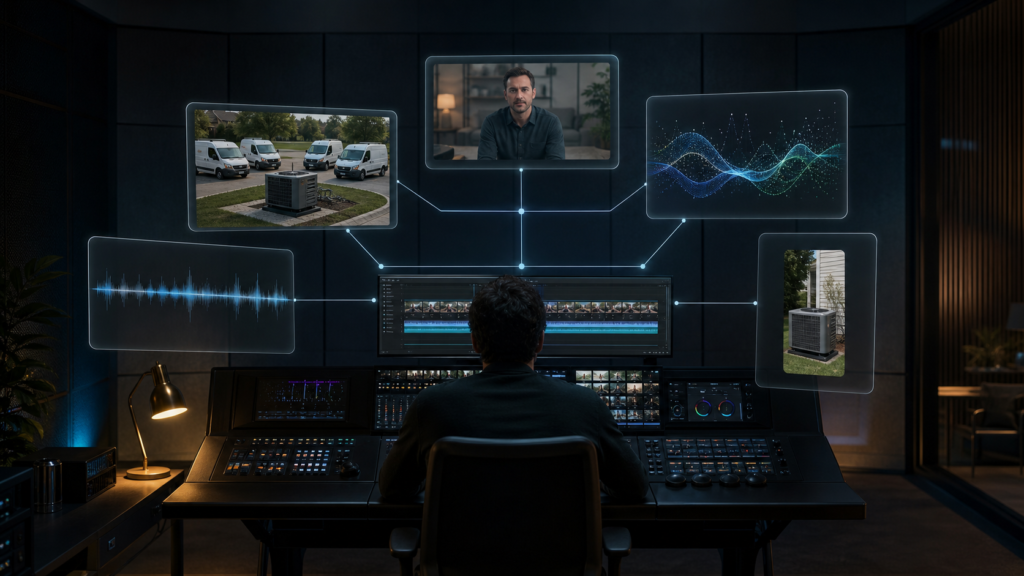
“Make an AI video” sounds simple until you try to make one that actually says something.
A useful AI video production workflow is not a prompt, a template, or an unattended content factory. It is the process that turns a real business point into a clear piece of video without losing the message, the proof, or the person behind it.
A local HVAC owner does not need six seconds of shiny, unrelated robot footage. They need a message that makes another owner recognize an expensive problem immediately. In this case, the message was simple: emergency calls usually turn into bidding wars. When the system dies, several companies race to the house, compete on speed and price, and the job becomes harder to win profitably.
The goal was not to make AI the star. The goal was to make that truth feel obvious in a fast vertical video.
That required more than typing a prompt.
It required a founder message, a visual plan, AI-generated inserts, reference images, sound design, local editing, quality control, and a human who could reject weak outputs instead of pretending every render was usable.
The brief was not “make HVAC B-roll”
The first useful question was not “what can the video generator make?” It was: what exact line deserves a visual payoff?
The founder’s spoken line described a homeowner calling multiple companies after a system failure. That gave us a literal visual idea: competing service vans arriving at the same dead outdoor condenser.
That is a much better starting point than generic footage of a technician, a calendar, a stock office, or a fake dashboard. Those visuals may look polished, but if they do not make the adjacent sentence clearer, they are filler.
The video needed a simple rhythm:
- Founder sets up the owner problem.
- A short visual shows the bidding-race reality.
- Founder lands the point: “That shit sucks.”
- Founder explains the better path: create demand before the emergency.
The audience should understand the joke and the business problem without needing an explanation after the video ends.
The first AI render taught us the right rule
The first version tried to do too much in one short shot: multiple vans, technicians, and a scuffle all competing around the same call.
It technically rendered. That did not make it good.
The action was crowded, the competition was not instantly readable, and the visual had the familiar problems that show up when a generator is asked to stage too many moving parts at once. We rejected it.
That rejection mattered. A bad render is not a sunk-cost reason to put bad footage into a finished post.
The replacement approach was simpler:
- one shot for the van race and hard braking;
- a second, matching continuation for a brief comedic shove-match;
- a hard cut back to the founder’s punchline.
Each generated shot had one job. The final edit only used the strongest moment from each one.
That is the difference between using AI as a novelty machine and using it as part of an actual production process.
The production workflow we used
Here is the workflow that finally made the post work.
1. Start with the real message
We used the founder’s actual spoken clips as the backbone. His voice did not disappear under generated audio or music. The AI inserts were there to make particular lines more visual, not replace the person making the argument.
2. Map the exact beat before generating anything
Before making a paid video render, we identified the words that the insert had to support. The van sequence belonged over the line about companies racing to arrive first and charge the least.
Later in the Reel, a separate supplied proof clip was placed only over the founder’s 55% qualified-lead increase and 34% lower ad-spend claim. The original founder audio continued underneath it.
That is a small editorial discipline with a big effect: every visual has a reason to exist.
3. Approve the reference, prompt, settings, and credit cap
For paid AI shots, we did not hit Generate and hope.
We prepared a clean reference still with the outdoor condenser, curb, driveway, and lighting already established. Then we reviewed the exact prompt, visual action, format, duration, audio setting, expected credit cost, and a one-render limit before spending credits.
When we wanted a second action after the vans stopped, we did not bolt on an unrelated clip. We extracted a stable frame from the accepted van shot and used that scene as the continuation reference.
That is how the second shot stayed in the same visual world.
4. Generate short shots, not a vague long movie
Short, controlled shots are easier to direct and easier to reject.
A single six-second shot can show the van race. A separate four-second continuation can show a quick, non-graphic scuffle. In the final Reel, we only need about a second of that second shot for the joke to land.
Trying to make one generation handle arrival, braking, exits, argument, fight, proof, and resolution creates visual mush. Breaking the sequence into shots gives each moment room to work.
5. QA the real output, not the prompt
Every generated clip was downloaded and checked as an actual video. We inspected chronological frames for:
- whether the promised action actually happened;
- whether equipment and vehicles remained believable;
- unwanted logos, text, or broken geometry;
- duplicated people or warped limbs;
- static endings that killed the pacing;
- whether the idea read at phone size.
If the render did not pass, it stayed out of the Reel.
6. Edit and sound-design locally
The final video was assembled locally as a direct 1080×1920 vertical master. The founder audio stayed continuous. We used a brief, licensed tire-screech accent under the van braking moment, then made a hard cut back to the founder’s line.
There is no need to ask a video model to generate every sound, every transition, and every second of the final post. A controlled edit is where the pacing becomes intentional.
7. Review first. Publish second.
The Reel was sent as a native vertical review video before publication. After the final proof B-roll replacement was approved, the exact 1080×1920 master was published as native video to Facebook, Instagram, and LinkedIn, and each post was verified separately.
That distinction matters: a local render is not a published post, and a successful upload is not the same thing as a verified public result.
We now use two AI-video production lanes
This project also produced a cleaner system for future video work.
Founder-led Reels
The founder’s real talking-head footage is the spine. AI makes only short, literal visual payoffs for exact spoken lines. The edit preserves the founder’s audio and returns to the founder for authority, the punchline, proof, and CTA.
This is the right lane when the person on camera is the credibility engine.
Voiceover-led Reels
A recorded voiceover becomes the spine. We map it into short visual beats, create one approved AI shot per beat, and assemble the passed shots under the continuous voiceover.
For a 30-second voiceover, that might mean five to seven short shots rather than one long, expensive, uncontrolled generation. If one shot is weak, we can replace that shot without throwing away the entire production.
What should not be automated away
The temptation with AI video is to automate everything: script, spokesperson, visuals, voice, captions, music, publish button, and the judgment call at the end.
That is usually where a business starts sounding like every other account using the same tool. The owner’s actual point gets replaced with a generic line about growth. The visual becomes a polished metaphor nobody remembers. Then the system publishes it because nobody was assigned to ask whether it helped the audience understand anything.
Some things are worth keeping human:
- the business problem worth talking about;
- the proof you are willing to stand behind;
- the line that deserves a visual interruption;
- the decision to reject a weak render;
- the final approval to put your name on the post.
AI can speed up the production work between those decisions. It should not erase the decisions themselves.
The real takeaway: AI needs a director
AI can accelerate the production work. It can help create a visual that would be expensive or impractical to shoot for a short social post. It can turn a clear idea into a useful pattern interrupt.
But it does not decide which line deserves the visual. It does not know whether a clip supports the message or distracts from it. It does not protect your budget, preserve the real voice, inspect a bad render, choose the best second of motion, or verify that the correct final video is live on the correct platforms.
That is direction.
The useful question for a business is not “Can AI make me content?”
It is: Can we make one honest, memorable piece of content that helps the right customer understand the problem we solve?
If the answer is yes, then the tools are worth using. If the answer is no, more generated footage will not fix the message.
Need a better production system—not more random content?
Pork Pixel starts with the expensive business problem, then figures out the right mix of message, creative, advertising, website, tracking, follow-up, automation, or content to fix it.
If you are looking for AI-assisted video production services, start with the business problem the video needs to explain—not a pile of generated clips. We can help you connect the creative to the ads, landing pages, and measurement that make it useful.
FAQ
Can AI make a complete marketing video by itself?
It can generate video material, but the useful result still needs a clear message, shot plan, brand judgment, editing, quality control, and an approval process. Treating a single AI output as a finished marketing asset is how generic footage gets published.
Is AI video only useful for tech companies?
No. The best use is often a literal visual payoff for a real-world service problem. In this case, the subject was an HVAC bidding war—not an abstract software concept.
Should every social post use AI-generated video?
No. Founder footage, real product proof, real customer context, or a simple clean edit is often better. AI earns its place when it makes a specific idea more immediate or memorable.
What makes an AI video feel trustworthy?
It should support a real message, preserve real proof and voice where appropriate, avoid fake claims, and be reviewed before it goes live. The production process matters as much as the visual effect.